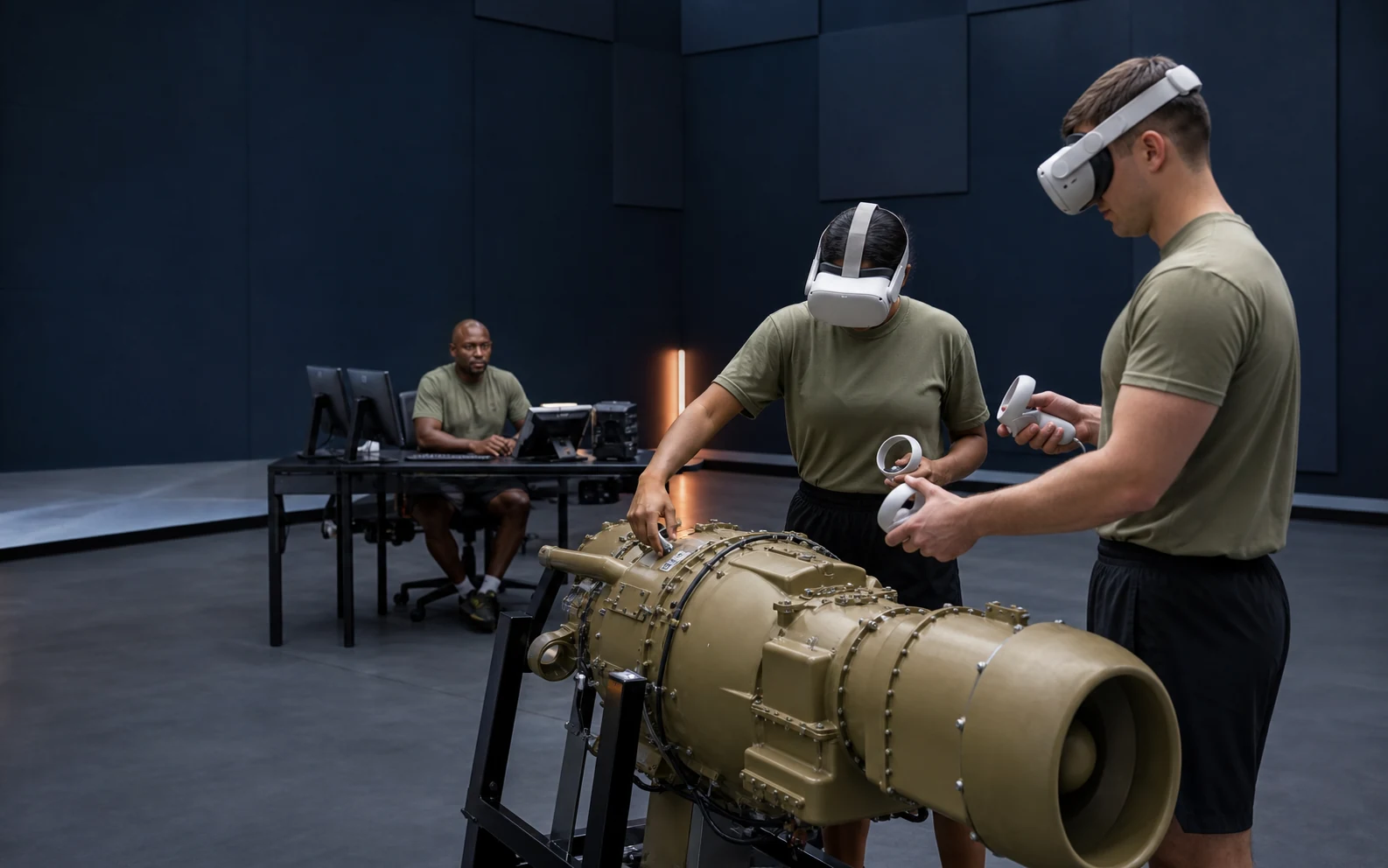
Operators are design partners
The people doing the work reveal constraints and cues that requirements documents rarely capture on their own.
Defense XR · Immersive training · Digital twins
Founder-led in Southern California
Delivery approach
A disciplined XR program makes technical risk visible early, keeps operators in the loop, and turns each phase into evidence for the next decision.
 Capability concept
Performance, networking, content, device limits, physical ergonomics, human factors, and program constraints all shape whether an XR solution works. PropelAR treats them as one design problem from the beginning.
From idea to field evidence
Every phase answers a decision that matters: what should be built, whether it works, what it takes to scale, and how it will live in the operational environment.
Discuss your starting pointObserve or reconstruct the task. Identify users, equipment, decisions, constraints, available data, failure modes, and a measurable definition of success.
Prototype the highest-risk interaction on representative hardware and content. Make assumptions tangible enough for operators and stakeholders to challenge.
Define devices, runtime, content pipeline, networking, data boundaries, integration points, security assumptions, performance budgets, and delivery plan.
Build a coherent operational slice with realistic procedures, equipment data, administrative controls, instrumentation, and a documented test plan.
Test in context, resolve usability and performance findings, document the system, train stakeholders, and define the path to sustainment or scale.
Engineering principles
These principles keep the work grounded when devices, data, environments, and program priorities are all moving at once.
The people doing the work reveal constraints and cues that requirements documents rarely capture on their own.
A strong prototype answers the hardest question. It does not spend the schedule polishing what is already understood.
Frame rate, thermal limits, battery, network behavior, tracking quality, and content budgets are part of the user experience.
Demonstrations, test results, decisions, architecture, and technical records make progress legible to both users and program leadership.
Typical working outputs
Deliverables are tailored to the engagement, but each one should reduce uncertainty or strengthen the program’s ability to move.
Users, tasks, constraints, success measures, available assets, risks, and recommended first proof.
Representative interaction, stakeholder feedback, technical findings, and a clearly bounded recommendation.
Architecture, interfaces, content pipeline, performance budgets, backlog, estimate, and validation plan.
Source, build guidance, test results, known constraints, operating notes, training, and sustainment recommendations.
Start small enough to learn
Bring the requirement, the equipment, or even the unresolved question. We’ll help frame an engagement around the evidence the program needs next.
Plan a discovery call